Pregnancy Complications
Infant- and Family-Centered Developmental Care
Respiratory Infections
Neonatal Eye Health
Hygiene
Rare Diseases
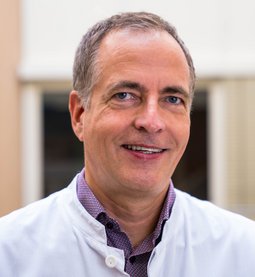
The European School of Neonatology (ESN), the educational arm of the European Society for Paediatric Research (ESPR), provides postgraduate education and training for neonatal professionals across Europe and beyond. Its programs are aligned with the European Training Requirements in Neonatology and combine academic learning with practical clinical training, including a strong focus on Infant- and Family-Centered Developmental Care (IFCDC). GFCNI supports the ESN in its efforts to strengthen high-quality neonatal education. We spoke with Professor Sven Wellmann, Chairperson of the ESN and Chief Physician at the University of Regensburg, Hospital St. Hedwig of the Order of St. John, about the future of neonatal education, the need for greater harmonization across Europe, and the role of family-centered care in training the next generation of neonatologists.
The European School of Neonatology (ESN) aims to strengthen neonatal education across Europe and beyond. What need was the ESN originally created to address, and how has its role developed since then?
In Europe, each country is responsible for the education of neonatology specialists within its own borders. Despite a unified European Training Requirement (ETR) in Neonatology, which has been approved by the highest European medical professional association, many countries lack a neonatal education programme altogether, and many others does not follow the ETR in Neonatology. This is a fundamental problem. Without structured education of neonatology specialists, there is neither recognition of neonatology as an independent discipline in some countries nor achievement of modern standards. Ultimately, the medical care of neonates in many countries and regions across Europe does not align with the latest best practices and medical evidence, resulting in unnecessarily high mortality and morbidity and poor long-term outcomes, especially among preterm neonates. In addition, a specialised field without implemented and validated learning standards risks going unnoticed, which is detrimental to the profession itself and the patients it serves. Thus, the ESN was established to substantially advance neonatal education across Europe by offering a supranational training programme that is affordable for and accessible to all trainees in neonatology.

Neonatal training and standards of care still vary considerably between countries. In your view, where are the most important gaps today, and how can more harmonized education help improve outcomes for newborns and their families?
Indeed, there is variation not only between countries but also within countries and even between neighbouring hospitals. Each medical subdiscipline has its traditions, different approaches and different schools of thought. As a young physician, you learn from your local colleagues, superiors, and medical role models how to perform surgery, deliver a baby, or treat a preterm neonate, for example. In order to prevent local traditions from becoming outdated, openness to medical progress and a willingness to exchange knowledge are key. The primary shortcomings lie in the failure to adhere to evidence-based standards, disregard for accepted medical principals, and lack of family-centred care. The ESN was established to overcome these gaps.
What should high-quality postgraduate education in neonatology look like today, and how must it evolve to meet changing clinical, educational, and societal needs?
We are at the beginning of major medical and societal changes. The value of knowledge is shifting from quantity to quality. With the help of artificial intelligence, medical knowledge will become much more readily and specifically accessible in a short time. The ESN aims to play an active part in this process and supports training in neonatology by not only providing and delivering knowledge but, crucially, by addressing education in professional competencies, manual and mental skills, and by fostering a patient and family-centred attitude throughout the curriculum. In addition to delivering high-quality postgraduate education through its novel and recently certified Master of Advanced Studies (MAS) in Neonatology and the established Master of Science (MSc) in Neonatology, the ESN is taking the lead in implementing a European exam in neonatology that will set the bar for meeting changing clinical, educational, and societal needs.
Why has the ESN made postgraduate education a central part of its work, and what role can structured, Europe-wide training play alongside national specialist training pathways?
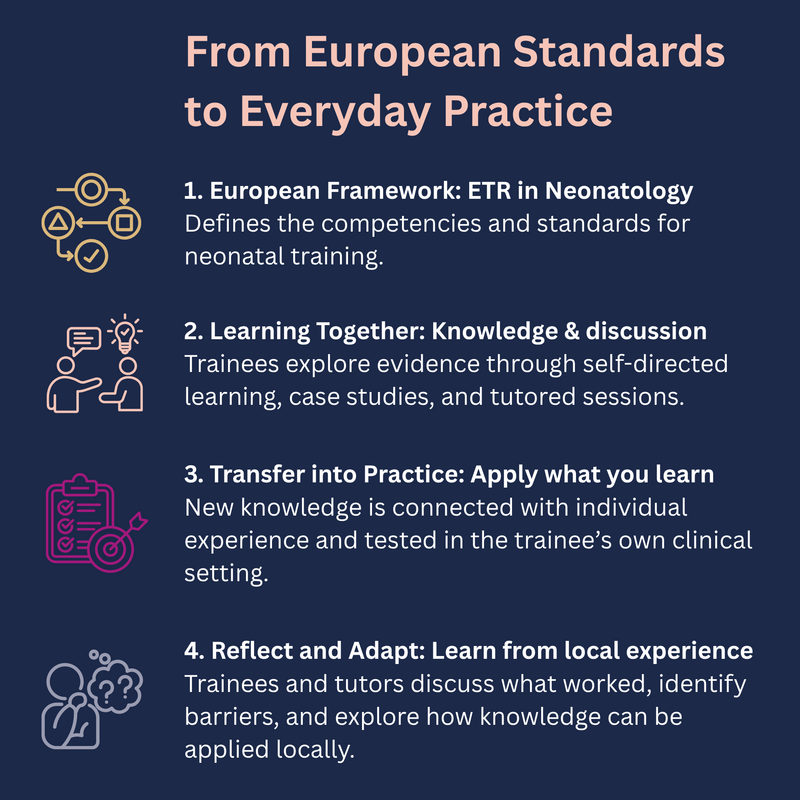
In fact, national specialist training pathways reflect national expectations, professionalism, and responsibilities. At a supranational level – which, in Europe, means the European level – frameworks and guidance can be provided. One such framework is the already mentioned ETR in Neonatology, which we recently presented and discussed in a scientific publication (Roehr CC and Wellmann S et al, 2025). The goal of the ESN is to provide a training platform for excellence in neonatology that reflects the latest medical evidence and offers a traceable and verifiable framework for postgraduate education integrated with each trainee’s local clinical work.
The program is aligned with the European Training Requirements in Neonatology. How does the ESN translate these requirements into competencies that participants can apply across different healthcare systems and clinical settings?
While the ETR in Neonatology sets the framework, the ESN puts it into practice. The ESN is based on modern learning principles that include self-directed learning, case studies, transfer tasks, and tutored sessions. Genuine learning relies on linking new knowledge with individual experience, practical application, and repetition. We have recently published these principles and described how they are integrated in the ESN (Santoro D and Wellmann S et al., 2024). The ESN offers an online learning platform where trainees and tutors regularly meet in small groups and discuss trainees’ experiences from their respective workplaces, explore ways to apply new knowledge, and identify and analyse local barriers.
Infant- and Family-Centred Developmental Care (IFCDC) is an explicit part of the MAS curriculum. Why should IFCDC be considered a core component of neonatal training rather than an additional or optional area of practice?
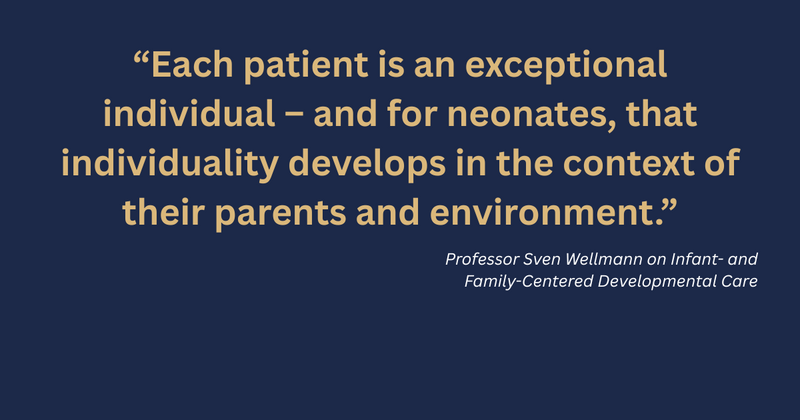
Yes, IFCDC is a core component. IFCDC signifies an approach to the newborn based on respect and appreciation, involving an understanding and treatment of the infant in light of their vulnerability and dependence on the family. Actually, as healthcare professionals in all medical disciplines, we have to understand that each patient is an exceptional individual and that neonates are only beginning to develop their individuality in the context of their parents and environment.
How can neonatal education help professionals move from understanding the principles of IFCDC in theory to consistently involving parents as partners in everyday clinical practice?
From theory to practice presupposes the opportunity to apply knowledge, to actually care for neonates, and to use the IFCDC principles in real work, i.e. in your specific local setting, with the next patients you care for and the next families you talk to. It also requires someone to supervise you and ask you how it worked out. This is real transfer into practice, which is a core didactic method of the ESN and outlined in the paper mentioned above.
Neonatal professionals need opportunities to continue learning throughout their careers. How can accessible formats such as lectures, podcasts, and shorter courses complement formal postgraduate training?
Updating knowledge and refining skills are indeed very important. Once the right learning attitude has been established and a solidfoundation has been built, as the ESN aims to provide, subsequent continuous learning becomes much easier. The ESN connects all trainees within an international network of peers and experts. There are many formats for continuous learning, each with specific advantages and disadvantages, but all are important because professionals have individual preferences and different ways of learning. I believe that social interaction and support for skill development are also important, particularly in helping professionals cope with demanding periods caused by insufficient recovery time and extensive on-call duties. Neonatology faces a high risk of staff shortages. That is why it is all the more important to clearly demonstrate the relevance of the field of neonatology – for patients, their families, and society as a whole.
What role can family- and patient-led organizations play in shaping neonatal education, and where do you see the greatest potential for collaboration with organizations such as GFCNI?
Family- and patient-led organizations in neonatology are of great importance. They represent the interests of the most vulnerable patients and draw attention to the needs that neonates and their families may be unable to voice themselves while dealing with or recovering from health issues. GFCNI helps draw public attention to an area that has been largely neglected from both medical and societal perspectives: childhood, motherhood, and parenthood, and particularly neonatology. GFCNI and the ESN have a common interest, namely state-of-the-art care for neonates across Europe and beyond. Therefore, GFCNI may advise the ESN about parents’ priorities and the best interests of their children, and both GFCNI and the ESN may join forces to advocate for their common goals.

Looking ahead, what qualities and competencies will the next generation of neonatologists need most – and what do you hope participants ultimately carry into their clinical practice?
In a time of rapidly increasing digitalisation, neonatologists, like all other medical professionals, need education that enables them toharness the benefits of digitalisation – for instance, online training at the ESN – while simultaneously retaining a deep respect for human reality and empathy. The next generation of neonatologist will acquire the skills, qualities, and competencies needed to represent their speciality confidently as an independent discipline positioned between obstetrics and paediatrics (Roehr CC and Wellmann S et al, 2026). Importantly, neonatology comprises the care of all neonates of all gestational ages and with all degrees of illness, including critical ill neonates requiring surgery and organ replacement therapy. My conviction is that ESN participants apply the knowledge they have acquired in their hospitals, inspire colleagues, and – as is already becoming apparent – contribute their local and individual experience to the ESN. In neonatology, there are so many diseases that are not yet fully understood and for which, consequently, no specific treatments are available, so advances in research and innovation are urgently needed. My vision is that the mutual exchange within the ESN, what participants ultimately carry into their clinical practice and feed back into the ESN, will help build a platform that advances neonatology as a whole across national borders.
GFCNI is the first global organization and network to unite patients, families, healthcare professionals, medical staff, and scientists from different disciplines, fields, and countries – all with the joint goal of advancing the health and quality of care for newborns and their families across the globe.
GFCNI is a non-profit organization established under German public law. Tax Reference Number: 143/235/22619
© 2026 GFCNI. All Rights Reserved.